Why NDEO? A conversation with our interns
NDEO's new executive director and this summer's interns think out loud about why membership matters.
-------------------------------------------------------------
I've been executive director of NDEO for a little over half a year. Long enough to learn a few things, and I still ask why we do things the way we do them. I hope that never stops. So instead of writing about membership on my own, I asked two of our summer interns, Jess Goodwin and Kendall Hayes, to make the case with me. Jess finished her B.A. last May. Kendall finishes her M.A. this summer. They're deciding right now what dance education will cost them and give them.
-------------------------------------------------------------
Ray: Jess and Kendall, thanks for chatting with me. Tell me how you each got into dance education, and how you came to know about NDEO.
Jess: Thank you too, Ray! It’s great to have this discussion with you two. I just received my B.A. in Dance with a concentration in Pedagogy from Brenau University last May, so I’ve come into the professional work-world of dance education slowly but surely and have considered my graduation to be jumping in with both feet. This came after 15 years of dance studio education, where I was very fortunate to have had teachers that emphasized the importance of dance education and encouraged me to just “go for it”. Once I made it to college, I was lucky to have professors that always encouraged my classmates and I to join something – an organization, a collective, etc. – post-grad to deepen our understanding of the working dance world and keep our eyes looking forward. My class was the first Brenau class to join NHSDA as our Honor Society, so chartering that chapter for our department and heading it as the senior representative was a huge privilege. So as a teacher, choreographer, and performer, I knew NDEO fairly well throughout school, and applying to be more involved as an intern after living the benefits seemed like a great fit (and it is!).
Kendall: Thanks for speaking with us, Ray! It’s great to be able to connect! I started dancing during my freshman year of high school and was fortunate to have an NHSDA chapter at my school. That experience helped spark my passion for dance education and led me to Ohio University, where I earned my BFA in Dance Performance and Choreography in 2025. This summer, I'll complete my Master of Arts Administration with a specialization in Community Dance, also from Ohio University. I've known about NDEO for several years, but I was especially excited to join the organization as a Marketing Intern this summer and continue my journey with such an inspiring community.
Ray: Almost every dance educator I meet believes deeply in dance education. They believe every student deserves access. They believe the work is serious and deserves dignity. They believe the field gets stronger when we build it together.
The hard part is what you do with that belief on a given day. In a school that cut your program's budget again. In a dance department where adjuncts teach more of the load every year and cost of living security feels thin. At a studio where rent went up and families can't pay for costumes this year. We work in a field that still argues for its own existence, and that gets tiring.
So I think about membership as a charge. Five of them, actually. Each one is something the field asks of educators right now, and each one is something NDEO does well when we work together.
You're both entering the profession in this economy, under this policy climate, deciding what deserves your working lives. Let me ask you about five charges.
The Five Charges
Charge one: Widen the door
Ray: Do you both believe every student should get to dance? I do. But believing it is the easy part. The hard part is widening the door, and right now that door is narrow: According to the Arts Education Data Project 2019 report: 2,742,803 students in schools had access Dance out of 17,934,402 total students, and 2,516 schools offer edDance (8% of schools). Those numbers were an improvement from prior surveys, and the current policy climate pushes against arts education access.
Access also means students feel the class belongs to them once they're in it. So what does it take to reach the students who never get a single dance class? And does an organization like NDEO feel like part of that answer to you yet?
Kendall: I think one of the biggest barriers to dance education is simply access. Many students face financial barriers that prevent them from taking dance classes outside of school, that was my experience. My family couldn't afford studio classes, so I started dancing through my public school. It wasn't that I needed to be "reached"; I just needed the opportunity to be reached. That's why I think organizations like NDEO are so important. They help advocate for greater access to dance education and ensure more students have the opportunity to discover dance, regardless of their circumstances.
Jess: I feel as though the main roadblock in dance education is, in agreement with both you and Kendall, access. To add onto that point, I feel as though understanding is also lacking in regards to what dance education means nowadays. Understanding of what the room offers, why diversity is paramount to that room, and what the things in the room actually leave a student with. Understanding leads to pursuit, which leads to greater need for access. A need for access makes things visible, showing the holes where they should be fixed. Back to the main point of picturing the students that aren’t in the classroom, I think that it really comes down to demands that those of us in the room have the voice to make, the willingness to share without worrying about what we get “in return”.
Charge two: Make the work visible
Ray: Do you believe in quality dance education for everyone, not only where it is already easy to find? If we want quality dance education everywhere, we have to say so out loud. You've spent time learning curriculum, assessment, classroom management, all the parts of teaching well that nobody sees. Nobody seeing it is the problem, because the people who cut the budget are never in the room when the work happens.
Advocacy means making the work visible before someone decides it was optional. Much of what NDEO does aims at that: the training, the data, the letters to the people who write policy, the OPDI courses, a conference every year with more than 200 peer-reviewed sessions built by working educators, a seat at national tables like the Arts Education Alliance and the National Core Arts Standards Council.
What part of your own work do you wish more people could see?
Jess: I think this question takes me by surprise a little bit, because educators (artistic and not) are used to being sort-of unsung heroes. Asking what we wish was visible asks us to consider the idea of showing out, something I think the arts could use more of these days. Personally, I wish people could see the change that happens slowly and all at once: The students that come to the studio to escape the walls of home, the smiles when a new move is done better than last week, the questions students give me that make me reconsider what I’m asking of them. Going above and beyond is the bare minimum in dance education, and in times like these, chugging full-speed-ahead is necessary. But even more necessary is slowing down and seeing the in-between moments that bring students back to dance, and back to themselves.
Kendall: I completely agree with Jess. Along with that idea, I wish more people could see everything that happens behind the scenes in a dance class. While students are learning technique, they're also developing so many transferable skills like communication, creative problem-solving, collaboration, resilience, and confidence. Through teaching my own classes, I've seen those skills grow just as much as their dancing. Those moments may not be as visible as a performance, but they're often the most impactful part of dance education.
Charge three: Raise the bar, with evidence
Ray: Do you believe dance deserves more respect than it gets? Dance still gets called fluff, a hobby, sometimes worse. As work and school move further onto screens, a person in motion, dancing alone or with other people, stays one of the few things fully ours. NDEO has made that case in policy rooms for almost 30 years, and we try not to argue from feeling alone.
Every new group of educators arrives with new ideas. An idea stays cheap until somebody tests it, writes it down, and hands it to the teacher who comes next. That handoff separates a field that builds on itself from one that starts over every generation. We publish the Journal of Dance Education and Dance Education in Practice so good work reaches teachers who never met the person who did it.
Has anything you've read about dance changed how you teach it? What was it, and where did it come from?
Jess: My junior-year self read this book inside and out, but as I progressed through my dance education, the book The Creative Habit by Twyla Tharp still stuck with me. The main takeaway that I received from Tharp’s writings was the notion of making something just to make it. Creating consistently allows us to view the world as raw material, and this has bled into my dance education while I hone my views and practices both in and out of the classroom. Making something is better than making nothing at all, and teaching to the best of your ability is always better than giving up on those willing to learn.
Kendall: Throughout my master's program, I studied the impact of community dance on physical, mental, and emotional well-being. Through coursework, I taught at an assisted living community, explored programs for individuals with Parkinson's, and facilitated a workshop on the connection between dance and mental health. Those experiences, along with the research I encountered, reinforced that dance doesn't always have to be performance-ready or technically focused. Sometimes, its greatest impact comes from its ability to heal, connect, and improve quality of life.
Charge four: Step outside of the silos
Ray: The dance world sorts itself into silos. K-12 teachers, studio teachers, college faculty, concert artists, mostly talking past each other. The wider culture pulls everyone into their own corner too. Working together takes a deliberate choice, made repeatedly.
NDEO holds every sector at once: about a third of our members in higher education, a third in K-12, a third in studios, community programs, and teaching artist work. The conference, the affinity groups and community meet-ups (online and in person), the mentorship program that pairs newer teachers with ones a few steps ahead, all of it is trying to get those groups into the same room.
Where have you felt those silos? And what would get you to cross one?
Jess: I have in fact witnessed these silos firsthand, especially in the jump from collegiate dance to the working world. Before that, I remember entering my college dance program and all of us looking at each other’s dance experiences with curiosity. I feel as though curiosity is the key when it comes to breaking down the silos you mention. That being said, I feel as though NDEO’s offerings in the way of cross-sector learning and discussion allow for that curiosity to mature and take up space. That kind of curiosity remains necessary, I think, especially as the dance world is subjected to rapid shifts and moments of “what’s next” in policy changes. “What’s next” should be each other: asking each other questions and listening to the answers in turn.
Kendall: Like Jess, I have also experienced those silos firsthand throughout my own journey. I started in public school dance, taught in private studios, studied dance in higher education, and now work in nonprofit arts administration. Each setting has something valuable to offer, but they don't always have opportunities to learn from one another. I think what encourages people to cross those boundaries is simply creating spaces for conversation and collaboration. Some of the best ideas come from hearing perspectives outside your own corner of the dance world. I agree with Jess as well that NDEO’s offerings allow for just that to happen.
Charge five: Teach the whole person
Ray: I think your generation already has this one. Dance education teaches the whole person, and it doesn't stop at 18, or at any age. It's a right across a whole life.
The job also reaches past the studio. We run programs, write grants, make the case to a principal, walk a shy kid into their first leadership role. Our members work as administrators, researchers, and organizers as much as teachers. NHSDA has inducted more than 50,000 students.
What skill do you wish somebody would help you build? And would you expect an organization like ours to give it to you?
Jess: I think that what I look forward to most as I grow myself and my perspectives in dance education is my ability to effectively organize and envision the bigger picture. It is easy to get lost in the detailed parts of a dance-education job, but I feel as though NDEO places fantastic emphasis on a forward-moving picture of what could be, what will be. Through emphasizing the proof through journals and publications, the personality in mentorships, the academia in presentations and discussions, the list goes on… but NDEO continues to ask each generation to keep moving, thinking, and dancing forward.
Kendall: As I enter the profession, I want to continue building my leadership skills. Teaching is only one part of the job… dance educators are also advocates, program builders, mentors, and community leaders. I think organizations like NDEO play an important role in helping emerging professionals develop those skills through mentorship, professional development, and connections with others in the field.
-------------------------------------------------------------
Possible Conclusions
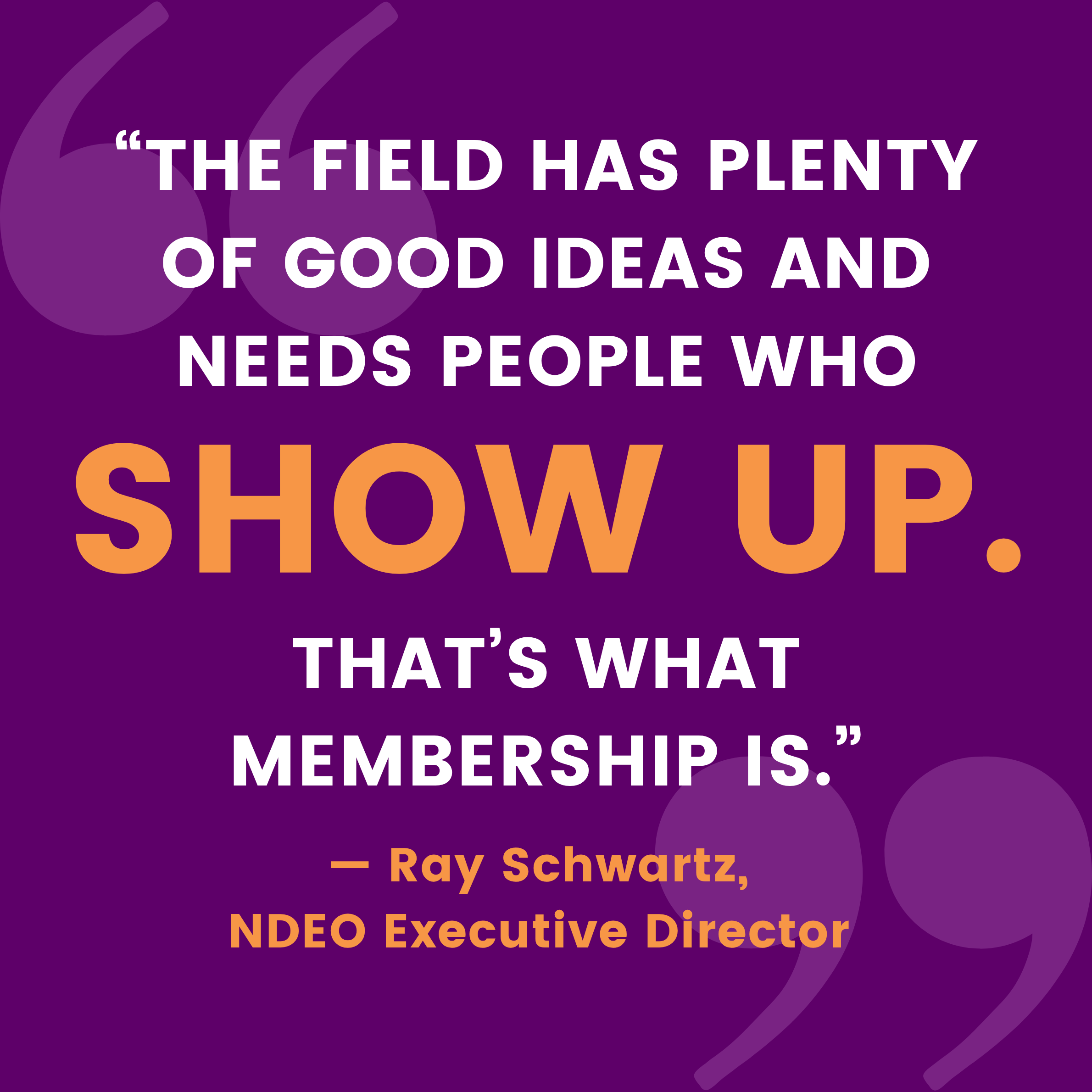
Ray: All of this stays philosophy until someone acts on it. The field has plenty of good ideas and needs people who show up. That's what membership is. It's where what you owe the field and what we owe you meet, and where a private belief becomes something we do out loud, together.
So I'll turn it around. What's your charge for NDEO? What do you want us to ask of you?
Jess: As a big fan of exchange in the arts, I find this question extremely relevant and, in all honesty, fun to consider. As dance education continues to be engaged with bigger, brighter ideas every day, I would enjoy seeing my generation be charged with creativity in turn. Creativity in answering questions, creativity in inclusion, creativity in working together. Ask young dance educators deeper questions, because believe me, we’ll love finding a new, exciting answer.
Kendall: I hope NDEO continues to ask me to lead with both creativity and purpose. I want to keep learning, advocating, and finding new ways to make dance education more accessible to others. If I can use what I've learned to create opportunities for even one more student to discover dance, then I know I'm helping move our field forward.
Take the Next Step
If you share these calls to action, membership in NDEO is the next step.
Join to Access Tools and Benefits to Support your Professional Growth - With your membership, you can enjoy tangible benefits like access to discounts on OPDI courses and the National Conference, resources like our scholarly journals, and opportunities for virtual and in-person networking.
Join to Align with a Mission that Matters - With your membership, you align yourself with our mission of advancing dance education for all people and become part of a community working together to make a difference in the lives of students across the country.
Join to Amplify your Impact - With your membership, you strengthen NDEO’s voice in national advocacy and signal to funders and partners that dance education is a vital cause worthy of respect and support.
A large and robust Membership base makes our work possible. As a non-profit professional association, NDEO relies on revenue from membership to keep the entire organization afloat. Simply put, our programs, services, and advocacy initiatives would not exist without your support as an NDEO member.
Visit our Membership page to learn more and JOIN today!
PS - If you want to establish a chapter of the National Honor Society for Dance Arts (NHSDA) make sure to sign up with an Institutional membership.